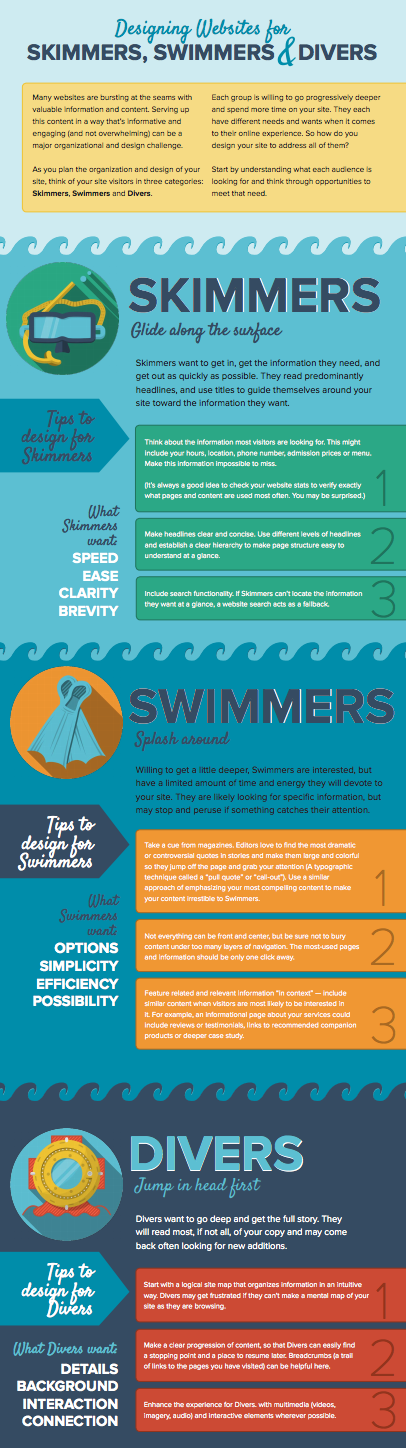


Many websites are bursting at the seams with valuable information and content. Serving up this content in a way that’s informative and engaging (and not overwhelming) can be a major organizational and design challenge. As you plan the information architecture and design of your site, think of your site visitors in three categories:
- Skimmers want to find the information they need and get out as quickly as possible. They’re often checking something quickly on the go, like confirming your hours or finding event details.
- Swimmers will go a little deeper and browse more of your site. They’re likely exploring with a purpose: comparing options, browsing services or programs, and looking for enough detail to decide what to do next.
- Divers want to take it all in and spend time exploring. They’re digging in to fully understand, exploring the details, and often returning over time to learn more or stay connected.
Each group is willing to go progressively deeper and spend more time on your site. They each have different needs and wants when it comes to their online experience. So how do you design your site to address all of them?
Start by understanding what each audience is looking for and think through opportunities to meet that need.
Skimmers
Skimmers want to get in, get the information they need, and get out as quickly as possible. They read predominantly headlines and use titles to guide themselves around your site toward the information they want. Skimmers want speed, ease, clarity and brevity.
Tips to Design Your Website for Skimmers
- Include search functionality. Many Skimmer will skip your navigation all together and look for a search tool as the fastest path to answers. Make it prominent.
- Use clear, descriptive headlines. Headlines should communicate meaning on their own. Avoid vague or clever language and prioritize clarity so visitors can scan and move quickly.
- Establish a strong visual hierarchy. Use consistent heading styles, spacing, and layout patterns so visitors can understand page structure at a glance.
- Surface key information immediately. Prioritize high-demand content like hours, location, contact details, pricing, or primary calls to action. Place these where users expect them, especially at the top of pages.
- Design for scanning behavior. Break content into short sections, use bullet points where helpful, and avoid dense paragraphs that slow users down.
- Validate with real data. Review analytics and search data to confirm what users are actually looking for. Use that insight to guide navigation, homepage priorities, and content placement.
Quick Check: Is Your Website Optimized for Skimmers?
- Can someone get to your most important information in under 5 seconds without scrolling?
- Are your headlines clear enough to understand the page at a glance?
- Is your primary call to action immediately visible?
- Can a first-time visitor orient themselves without thinking about where to go next?
Swimmers
Willing to go a little deeper, Swimmers are interested but have a limited amount of time and energy to devote to your site. They are likely looking for specific information, but may stop and explore if something catches their attention. Swimmers want efficiency and clear options.
Tips to Design Your Website for Swimmers
- Highlight what matters most. Take a cue from magazines and use visual emphasis like featured sections, pull quotes and callouts to draw attention to key messages and guide exploration.
- Connect related content. Keep users moving by linking to relevant pages, resources, or next steps within the context of what they are already viewing.
- Keep navigation shallow and intuitive. Organize content logically and ensure visitors can reach important pages in one or two clicks.
- Support decision-making. Include helpful details like comparisons, FAQs, or quick summaries that help users evaluate options efficiently.
- Balance depth with efficiency. Provide enough information to build confidence, but structure it so users can choose how far they want to go.
- Use clear calls to action. Give users an obvious next step on every page, whether that’s contacting you, exploring a service, or viewing related content.
Quick Check: Is Your Website Optimized for Swimmers?
- Do your pages guide users toward a clear next step?
- Is related content surfaced at the right moments?
- Can someone quickly compare options or understand what makes each offering different?
- Do you have important content that takes 3 or more clicks to get to?
Divers
Divers want to go deep and get the full story. They will read most, if not all, of your copy and may come back often looking for new additions. Divers want details, background, and connection.
Tips to Design Your Website for Divers
- Build a clear and logical structure. Group related content thoughtfully so users can follow a natural path. Divers may get frustrated if they can’t make a mental map of your site.
- Create depth without confusion. Offer detailed content like case studies, long-form pages, or resource libraries, but keep navigation and labeling clear so users don’t get lost.
- Show progression and orientation. Use tools like breadcrumbs, section labels, and consistent layouts to help users understand where they are and how to move through the site.
- Invest in high-quality content. Divers are looking for substance. Provide thoughtful, well-structured content that answers questions thoroughly and builds trust.
- Layer in richer experiences with multimedia and interactivity. Use video, imagery, interactive elements, or downloadable resources to support different ways of engaging with content.
- Keep content fresh and expanding. Give returning users a reason to come back by regularly adding new content and making it easy to discover.
Quick Check: Is Your Website Optimized for Swimmers?
- Does your site provide enough depth to fully answer key questions?
- Is your content organized in a way that supports deeper exploration?
- Can users easily pick up where they left off when they return?
- Do you offer content that builds trust, like detailed explanations, examples, or supporting resources?
A Simple Framework to Structure Your Website Content and Design
Using the simple but effective Skimmers, Swimmers, Divers framework ensures your website supports all types of visitors to drive higher engagement and conversions. It’s practical approach we use every day in our work on custom websites, and shapes how we approach sitemap planning, content structure, and page design.
View the Old-School Infographic Version
We made this infographic back in they day when infographics were all the rage. It’s still a pretty fun way to consume information if you ask me (and Skimmers, Swimmers, Divers-friendly!). I think we should bring them back. If you’re with me, you can view and download the infographic PDF.
(Click to view larger.)